

Hot-Shot Pipe Thawing Machines for Frozen Metal Water Lines
A frozen water line can turn into a surprisingly destructive job if the only way to reach the blockage is through a wall, floor, crawl space, or frozen ground.
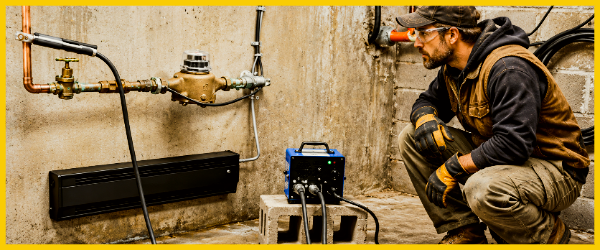
That is what makes General Pipe Cleaners’ Hot-Shot pipe thawing machines useful. Instead of exposing the frozen section or applying an open flame to the pipe, the Hot-Shot sends low-voltage, high-amperage current through the metal line. The pipe warms enough to begin thawing the ice along its walls, and once water starts moving again, the remaining blockage can continue to melt.
For plumbers, maintenance crews, municipalities, and property managers dealing with frozen metal water lines, that can mean restoring service without first turning the job into an excavation or repair project. General Pipe Cleaners specifies the Hot-Shot for copper and iron pipe.
The Frozen Section Does Not Have to Be Exposed
One of the biggest advantages of a Hot-Shot is that the clamps do not have to be attached directly beside the ice blockage.
The cables are connected to accessible points on either side of the frozen section. Current travels through the continuous metal pipe between those clamps, warming that section of line.
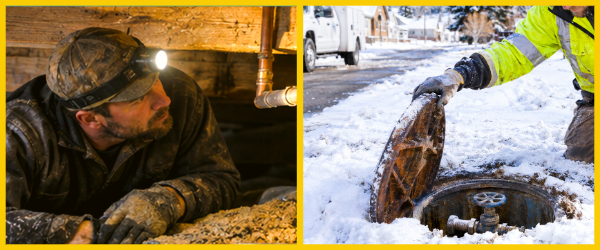
That matters when the frozen area is buried, behind a wall, under a floor, or running through a crawl space where exposing the entire pipe would add significant time to the service call.
In actual winter service work, that difference can be substantial. A technician may arrive at a house with several frozen runs, thaw one section, reposition the cables, and move to the next without cutting into walls or floors to reach each frozen section. On one Northern Michigan farmhouse job, a plumber used a Hot-Shot 400 to restore water to the kitchen in less than ten minutes, then moved the machine to a second frozen line and restored bathroom service about ten minutes later.
How the Hot-Shot Actually Thaws the Pipe
The Hot-Shot does not need to make the pipe extremely hot. General Pipe Cleaners describes the system as applying roughly 5 volts at high amperage through the metal pipe. The electrical resistance of the pipe creates heat, raising the pipe temperature enough to thaw the outer layer of ice against the pipe wall. Once that layer opens, water pressure helps melt the remaining frozen section and restores flow.
That is very different from trying to heat one exposed spot with a torch. The thawing action occurs along the metal path between the two clamps.
Pipe material also affects how quickly that happens. General Pipe Cleaners notes that copper does not heat as quickly as iron and estimates approximately 30% longer thawing times for copper under similar conditions. Actual thawing time also varies with pipe diameter, pipe length, cable gauge, and other job conditions.
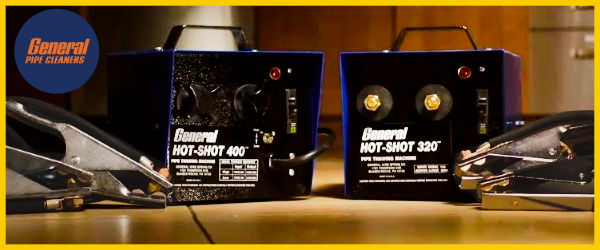
Hot-Shot 320 or Hot-Shot 400?
The difference between the two machines is mostly about how much line needs to be thawed and what electrical service is available at the jobsite.
The Hot-Shot 320 delivers 320 amps while drawing 14 amps. General Pipe Cleaners rates it for up to 100 feet of 1-1/2-inch metal pipe. At 30 pounds without cables, it is compact enough to carry into basements, crawl spaces, mechanical rooms, and other service locations. It includes a 15-amp circuit breaker and thermal overload protection.
The Hot-Shot 400 extends the working range to as much as 175 feet of 1-1/2-inch metal pipe. It provides two output settings:
- 400 amps with a 20-amp draw
- 320 amps with a 14-amp draw
That lower setting can be particularly useful at older residential or commercial properties where a 20-amp circuit is not available. The technician can switch the 400 to the 320-amp output rather than losing the ability to use the machine altogether. The 400 weighs 31 pounds without cables and includes a 20-amp circuit breaker and thermal overload protection.
For shorter runs and jobs where 320 amps is enough, the 320 keeps the setup simple. For longer frozen sections or crews that want the flexibility of both output levels, the 400 provides more range.
Good Clamp Contact Matters
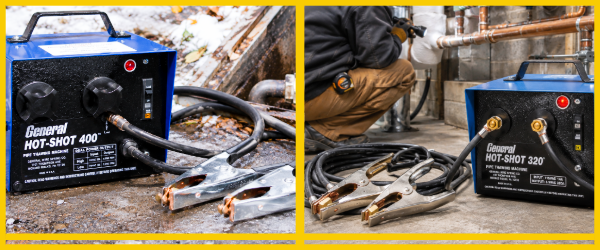
The machine can only send useful current through the pipe if the electrical path is good.
That makes clamp placement and connection quality important. The clamps need clean contact with the metal pipe, and the frozen section must lie between the two connection points.
Cable length matters too. General Pipe Cleaners notes that longer cables require a larger gauge; using undersized cable reduces the available current and can slow the thawing process.
This is one of the practical differences between simply owning a pipe thawer and getting good results with one. A poor electrical connection, unnecessary cable length, or a pipe configuration that allows current to take another path can reduce how much heat reaches the frozen section.
Why Contractors Keep These Around in Cold Weather
A frozen-pipe call is usually not a job where the customer wants to hear that the crew needs to start opening walls or digging frozen soil just to find out whether the line can be thawed.
Hot-Shot gives contractors another option: connect to accessible metal pipe, thaw the frozen run electrically, restore flow, and then deal separately with whatever insulation, air leakage, or exposure caused the pipe to freeze in the first place.
That is also why these machines make sense for municipal crews and maintenance departments that see the same problem repeatedly during severe weather. The equipment is compact, reusable, and can move from one frozen line to the next without bringing welding equipment or open-flame heating into the job.
RTO offers General Pipe Cleaners Hot-Shot pipe thawing equipment for frozen metal water-line applications. For help choosing between the Hot-Shot 320 and Hot-Shot 400, contact RTO with the pipe material, diameter, approximate frozen length, available electrical service, and job conditions.